
Good months, slow months and fixed dates
Elena’s year had a predictable shape. Spring and early fall brought weddings and engagement sessions, and November and early December meant holiday portraits. January and February were quiet, and a summer month could go either way depending on bookings.
Payment timing added a second layer. Some clients paid a deposit when they booked and the rest after delivery, while others paid an invoice weeks after the shoot. A busy month of work could turn into a thin month of income if several invoices were slow, and a quiet month could bring in money from shoots finished earlier.
Her costs ran on a different pattern. These came out on fixed dates:
- rent on the first of the month
- phone, internet and car insurance
- photo editing software, billed monthly
- cloud storage for client galleries
- website and portfolio hosting, billed once a year
- a music plan she played while editing
Other costs had no set date: a lens repair, new memory cards, travel to a shoot in another town. Some were business costs and some were personal, and in a slow month they all competed for the same money.
The hard part was the mismatch. In a busy month the fixed bills barely registered. In a slow one the same bills arrived on the same days, and a yearly hosting renewal that landed in February felt very different from the same charge landing in September.
Elena plans around her best month
Elena wrote her first budget in October, using the numbers from a strong September. It seemed reasonable at the time: the month was recent, she had worked hard for it, and it looked like a fair picture of what her business could do. She set her spending lines to match, and through the fall they mostly fit.
Then winter came. The budget assumed income that was not arriving, so she moved bills around, put off the lens repair and, in February, paid the hosting renewal out of money she had meant for groceries. Each slow month felt like falling behind, even though her business was doing what it did every winter.
Building a budget on the best month is a common first move for freelancers, since a strong month is fresh in memory and pleasant to plan around. A budget built on the average month runs into a similar problem when the swings are large. It asks too much of the slow months, and in busy months the extra money has no job, so it tends to get spent.
A budget with irregular income, built from the bottom
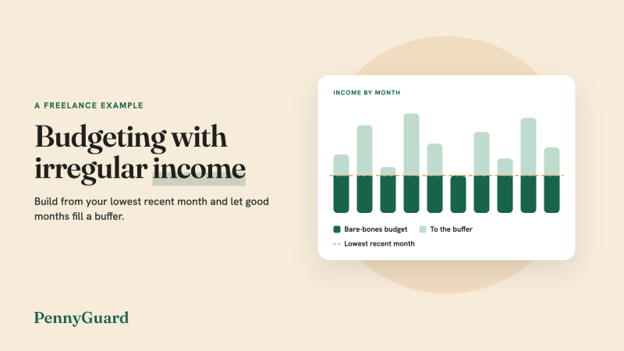
Elena rebuilt the budget from the other end. She looked back over the past year, picked her lowest recent month as the baseline, and wrote a bare-bones budget that a month like that could cover: rent, utilities, phone, insurance, groceries, transportation and the business tools she needed to keep working.
Next she listed each fixed cost with its due date, in date order, so she could see which week each one would leave her account. In good months, money above the baseline went first to a buffer, kept apart from everyday spending money, to carry her through the slow ones. Only after the buffer reached the level she had chosen did extra income go to other goals. She also added a small monthly line for irregular costs such as repairs and memory cards, so a broken lens would come out of money set aside for it.
Renewal dates were where PennyGuard came in. Elena used the subscription cancellation app and budget tracker for the recurring part of her spending. PennyGuard gathered her subscriptions and recurring bills into one list, along with any duplicate charges, and it was up to her to confirm which subscriptions were hers.
With upcoming charges visible before they renewed, she marked the renewals that fell in her slow months. A renewal coming up, or a change in price, brought a heads-up from PennyGuard in the app and by email. She could open a subscription to check its next renewal date and earlier charges. Her monthly spending appeared in PennyGuard too, a figure she set against her baseline at each review.
PennyGuard showed information and options, and nothing was sent until she confirmed, so the decisions stayed with her. The transparency page sets out how PennyGuard keeps decisions with you.
Elena’s own calls followed from the dates. She asked her hosting provider whether the yearly renewal could move to a month in her busy season. She kept the editing software, which she used every working day, and the music plan. She moved older client galleries to an external drive and stepped the cloud storage down a tier. She also set herself a rule: in any month that came in under the baseline, she would draw from the buffer instead of moving bills around.
What you can take from this
Elena happens to be a photographer. The same approach fits other freelance, seasonal, commission and gig work.
Start from a baseline month
Look back over the past twelve months and pick a low month that still looks realistic, leaving out a one-off month if something unusual happened. Build a budget that month could cover. In any given month, income above the baseline is extra, and it helps to decide its job in advance.
Rank your spending before a slow month arrives
Write a priority order for a lean month, so the choices are made ahead of time instead of under pressure. A common order starts with housing and utilities, then food, transportation and insurance, then the tools you need to earn, then savings, then extras. Your own order may differ. Settle it while income is steady, and keep it somewhere you will see it.
Build a buffer from good months
A buffer is money set aside to cover the gap between a slow month and the baseline. The size of the buffer is your call, and many people build it gradually. Keep it apart from everyday spending money so its purpose stays clear, and top it up first when a strong month comes in.
Plan for costs that come once or twice a year
List the costs that do not arrive monthly: yearly renewals, equipment repairs, professional dues, a new laptop every few years. Divide the yearly total by twelve and move that amount into a set-aside line each month. When the charge comes, the money is already waiting, whichever month it falls in.
Make the income side more regular where you can
Some of the unevenness can be smoothed at the source. Asking for a deposit at booking, sending invoices on the day you deliver the work and stating a due date on each invoice can all shorten the wait. Picking one day a week to follow up on unpaid invoices keeps them from drifting.
Pay yourself a steady amount if it fits
Some freelancers send client payments to one account and move a set amount to their everyday account on the same date each month, like a salary. On the spending side, a slow month then looks much like any other, as long as the buffer can cover the difference. For that reason the steady amount usually comes after the buffer is built, and many people start with a smaller one. If you are self-employed, a tax professional can tell you what to set aside.
Review once a month
Pick a date each month to compare income, spending and the buffer. Adjust the baseline if your lowest months change, look ahead at renewals and yearly bills due in the next slow season, and note which invoices are still outstanding so you can follow up on them.
A short checklist
- Find your lowest recent month and build a bare-bones budget it could cover.
- List fixed costs with their due dates, in date order.
- Write a priority order for spending in a slow month.
- Send money above the baseline to a buffer first in good months.
- Consider paying yourself a set amount on a set date once the buffer allows.
- Note which month each yearly renewal lands in.
- Review income, spending and the buffer on the same date each month.